


AgentOps: Bringing AI Agents from Demo to Production
An AI agent that responds fluently in a demo may not necessarily run correctly when handling thousands of real requests every day. Unlike traditional software, large language model (LLM)-based agents exhibit non-deterministic behavior: given the same prompt, two runs may take two different paths. This is why many AI projects stall at the pilot phase.
Recently, Google Cloud published the document Startup technical guide: AI agents, a technical roadmap for teams looking to bring agents into production environments. The VISSSOFT team has thoroughly reviewed this document. Below are the points we consider most valuable for Vietnamese enterprises, even if they do not use Google's infrastructure.
An agent consists of five components
The document divides all agents into five blocks: models (the reasoning brain), tools (APIs, databases, and internal systems that the agent is permitted to call), memory, orchestration (the reasoning – action – observation loop), and runtime environment.
Two notable points:
Choose a model that is just sufficient, not the strongest one. Overinvesting in model capabilities is a common mistake. Many steps only require small, fast, and inexpensive models.
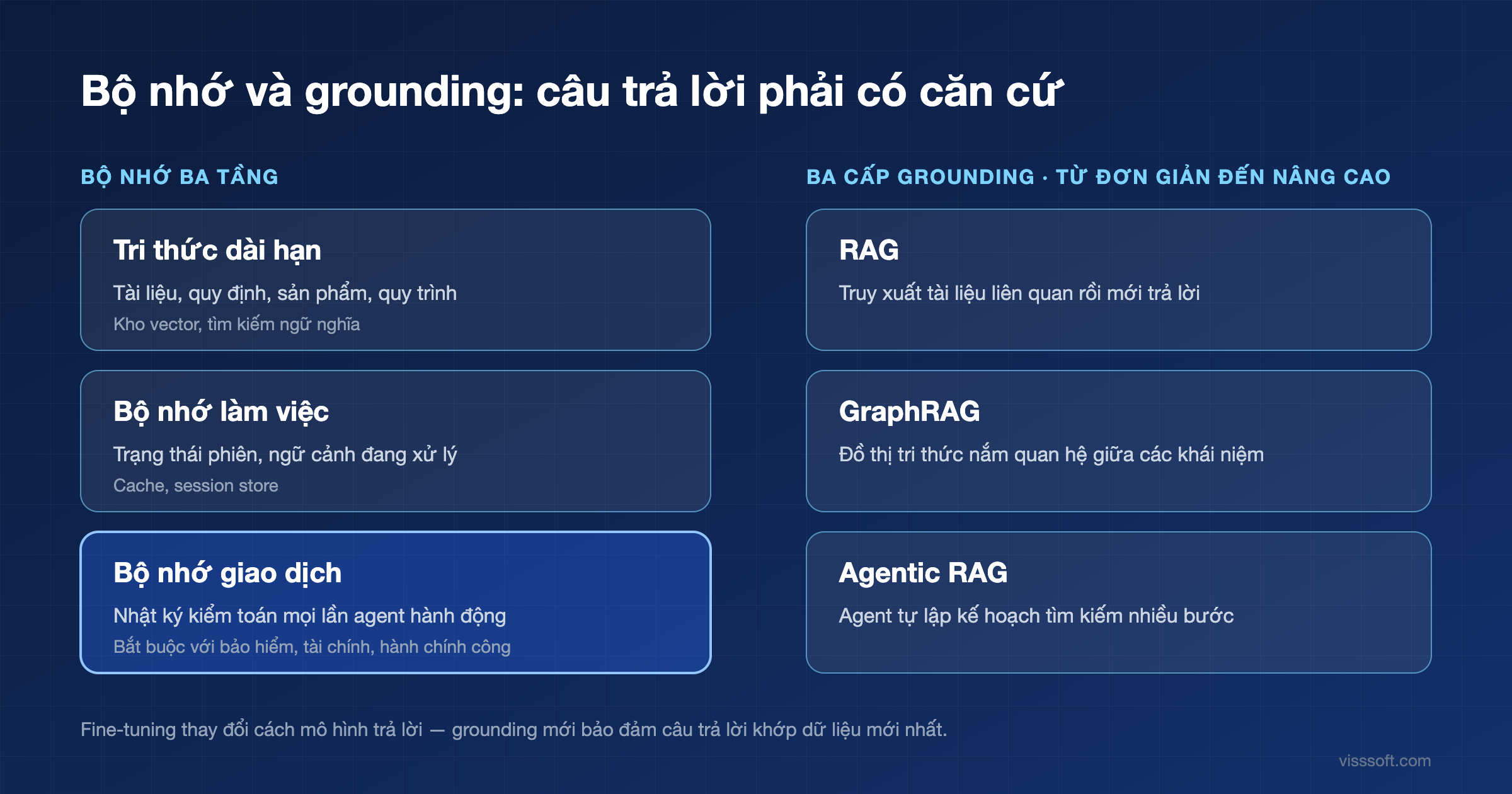
Memory should be split into three tiers: long-term knowledge (documents, regulations), working memory (session state), and transactional memory (audit logs). The final tier is often overlooked, but it is mandatory for operations that require traceability, such as insurance, finance, and public administration.
Grounding: answers must be evidence-based
To prevent the agent from "hallucinating", answers need to be anchored in verifiable data. The document describes three levels: RAG (retrieving relevant documents before answering), GraphRAG (using knowledge graphs to understand the relationships between concepts), and Agentic RAG (the agent autonomously plans multi-step searches).
A crucial insight: fine-tuning cannot replace grounding. Additional training changes how the model responds, but it does not guarantee that the answers align with the enterprise's latest data.
Separating deterministic parts from reasoning requirements
Not every step requires LLM decision-making. Business processes that must follow a strict sequence should run on fixed flows (sequential, parallel, or loops with conditional stopping criteria). Only steps that require understanding context, classification, or synthesis should be delegated to the reasoning agent. This approach makes the system much easier to control and test.
Regarding the tools used by agents, the document provides practical rules: clear names, accurate descriptions of when they should and should not be used, and a distinct, single purpose for each tool. Functionally overlapping tools are the primary reason agents make incorrect choices or enter infinite loops.
AgentOps: four-tier agent testing
This is the section we appreciate the most. AgentOps applies DevOps and MLOps principles to agents, replacing the "test a few prompts and if they look fine, deploy" mindset with a systematic evaluation process:
Component testing: each tool is tested with valid data, invalid data, edge cases, connection errors, and timeouts.
Reasoning path evaluation: checking not just the final output, but whether the agent selects the correct tools, passes the correct parameters, and follows the right sequence. A set of sample prompts along with expected paths is re-run whenever changes are made.
Output evaluation: assessing whether the answer is factually correct, grounded, comprehensive, and useful, scored by a combination of evaluation models and business experts.
Operational monitoring: tracking tool error rates, latency, the number of reasoning steps per task, and user feedback to detect early signs of agent behavior "drift".
The bottom line: prompts are source code. Any changes to code, tools, or model prompts must go through a CI/CD pipeline featuring automated evaluation steps prior to deployment.
Security in depth
The document recommends granting minimum privileges to agents so that even if the logic is compromised, the agent still cannot access unauthorized resources. Inputs must be checked against prompt injection attacks, outputs need to be filtered, and every tool call made by the agent must be logged for auditing purposes.
Perspective from VISSSOFT
The document is written for the Google Cloud ecosystem, so the product selection section should be tailored to each enterprise's context. For many clients in Vietnam, particularly in insurance, finance, and the public sector, sensitive data must be processed within self-managed infrastructure in compliance with Decree 13/2023/NĐ-CP on personal data protection.
The good news is that core principles such as three-tier memory, grounding, four-tier evaluation, and defense-in-depth security are vendor-agnostic. They can be applied to open-source models running on-premise, internal source code repositories, and the enterprise's own container infrastructure. Additionally, we recommend two principles that the document does not emphasize enough:
Agents act under the permissions of the requesting user, rather than using a broad-permission service account.
Any irreversible action (sending documents, approvals, payments, deleting data) must require human confirmation.
VISSSOFT accompanies enterprises and government agencies in designing, testing, and operating AI agents, from use-case assessment to deployment on secure infrastructure. Contact us for consultation on a suitable roadmap.
References: Google Cloud, Startup technical guide: AI agents